Map pathomechanisms without losing the causal steps
Line MindMap · · Study workflow
Separate causes, intermediate changes, and outcomes so your study diagram explains a mechanism rather than listing facts.
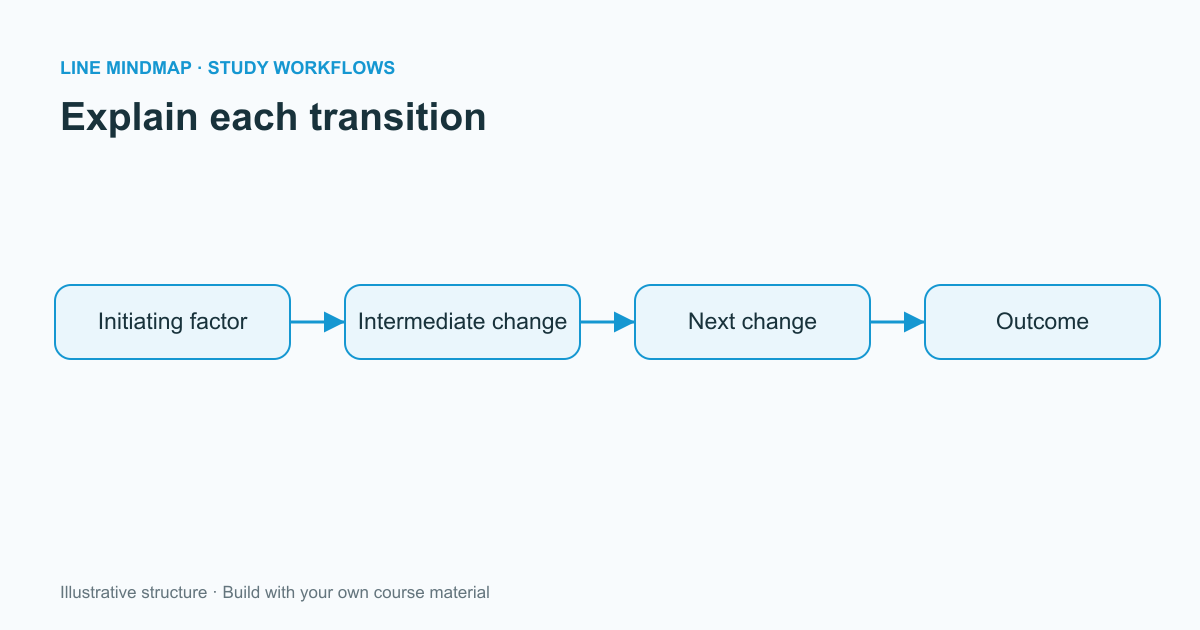
A mechanism diagram should help you answer “how does this lead to that?” A list of associated findings can be useful, but it does not necessarily explain causation. Start by choosing one mechanism from your course material and defining the beginning and end of the explanation you want to build.
Separate categories before drawing arrows
In a mind map, create branches for the initiating factor, intermediate changes, consequences, and unresolved questions. This first pass is an inventory of ideas. Keep it distinct from the sequence itself: a topic being near another topic on a map does not prove that one causes the other.
Once the outline is clear, use the flowchart workspace for the ordered explanation. Put one meaningful step in each process box. If a single box contains several events joined by “and,” consider splitting it so you can inspect each transition.
Label what the connection means
An arrow can represent time, causation, a decision, or simply a navigation route. Choose the meaning deliberately. Use a short connection label when the relationship would otherwise be ambiguous, and keep qualifications in your notes or source material.
- Identify the initiating event or condition.
- Explain the intermediate change rather than skipping directly to the outcome.
- Separate parallel pathways when your source distinguishes them.
- Record uncertainty instead of drawing a confident connection you cannot support.
Keep evidence alongside the explanation
Record the textbook section, lecture reference, or article you used in your mind map notes. When two sources differ in scope, avoid silently combining them into a single universal sequence. A simplified learning diagram should say what it is simplifying and which context it describes.
The example illustration accompanying this post is deliberately generic. It demonstrates organization and does not describe a specific disease or clinical pathway. Line MindMap provides the drawing structure; it does not validate medical relationships or generate an authoritative mechanism.
Review from the arrows outward
Before revising the appearance, check every connection. Can you explain it in a sentence? Is an intermediate step missing? Does the diagram distinguish a necessary step from a possible consequence? Fixing these questions is more valuable than adding more colors.
Finish by exporting a readable diagram and retaining the editable file. Return to the sources whenever you revise the mechanism, especially if you later reuse the material in a case discussion. Study diagrams are learning aids, not instructions for patient care.